Ibanez headless basses arrived in 2020, during a period when headless instruments were coming back into music.
Headless basses were not new. Steinberger had already made the shape iconic in the 1980s, and for a while that look carried a very specific futuristic image: compact body, no headstock, almost like a bass from a different industry.
Then the idea cooled off. For years, headless instruments felt like a niche. Some players loved the practicality. Others considered them odd.
But times have changed. Travel, home recording, extended-range instruments, and long practice sessions all made the headless idea feel useful.
Ibanez entered that moment with the EHB series – Ergonomic Headless Bass.
The main idea: this bass should be easier to hold and easier to play for a long time.
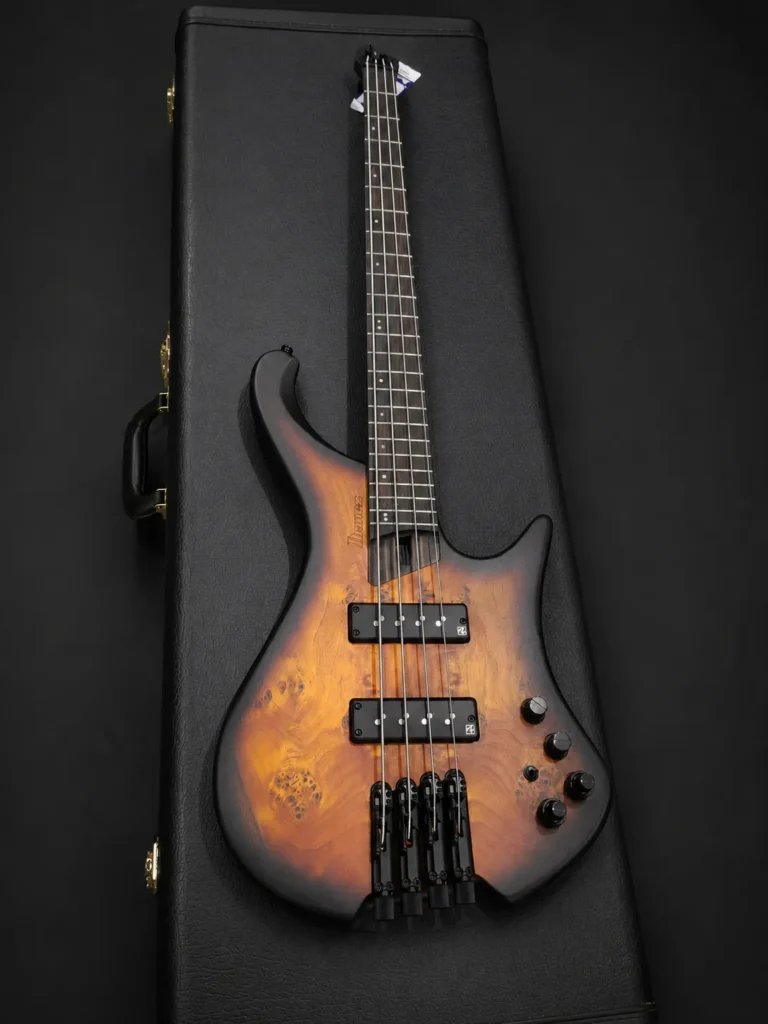
So are EHB basses actually comfortable?
For many players, yes. The EHB is one of the most comfortable bass guitar lines Ibanez has ever created. But the comfort does not come from the missing headstock alone. It comes from the whole design: balance, weight, body angle, strap position, upper-fret access, and the way the bass sits against the player.
But there’s a catch. EHB comfort is not universal. If you anchor your thumb hard on the pickup, dislike very light instruments, or need a traditional body mass against your ribs, an EHB can feel strange.
Table of Contents
Why Headless Bass Came Back
Headless basses solve one obvious problem before the player even plugs in.
They remove weight from the far end of the neck.
On a traditional bass, the headstock, tuners, and long neck all pull away from the body. If the body shape and strap button placement do not fight that pull, the bass starts to dive. A bassist can compensate with the fretting hand, a wider strap, or posture, but the body still knows what is happening. After a long set, small balance problems become shoulder, wrist, and hand problems.
Headless design changes this. The tuners move to the bridge area. The neck has less weight hanging from the end. The instrument can be shorter overall without shortening the scale. For bass players who rehearse, travel, record at a desk, or play long sets, this is crucial.
That is why headless basses came back at the right time. Modern musicians are less tied to a single location. A bassist might track at home, carry gear on public transport, play five-string low-B parts, sit in front of a computer, and then play a long set on a small stage. A lighter, shorter bass solves a real problem.
Was The EHB Made For Comfort?
The first mistake is thinking every headless bass is automatically ergonomic. It is not.
A headless bass can still be uncomfortable if the body is awkward, the strap balance is wrong, the bridge sits in a bad place, or the right hand has nowhere natural to live. Headless construction removes a problem, but it does not finish the design.
Ibanez did more with EHB. The body is compact and chambered. The back is slanted so the bass can sit slightly closer to the player. The edges are rounded. The lower horn area is carved for upper-fret access. The strap balance is part of the shape. The bridge and headpiece system are specific to the series. Many models also add multiscale design, stainless frets, active/passive electronics, and adjustable string spacing.
The bass is trying to remove little fights: the neck pulling down, the body sitting too far away, the upper frets feeling blocked, the instrument feeling larger than it needs to be, and the player having to hold the bass in position instead of simply playing it.
Standing is where the headless design makes the fastest impression. The EHB bass does not feel like it is dragging the neck toward the floor. That changes the job of the fretting hand. Instead of supporting the neck while also playing notes, the left hand can stay closer to its real job: shifting, muting, fretting, and controlling pressure.
A full-size traditional bass can feel awkward in a chair. The neck reaches far left, the headstock hits furniture, and the body may force the right shoulder into a position the player does not notice until the session is over. The EHB design reduces the overall dimensions. The bass still feels like a bass. It just takes up less space around the player.
The chambered body is not just a marketing detail. A bass can feel fine for five minutes in a shop and become annoying after two hours of practice. A few pounds change how the strap sits on the shoulder and how much the player moves while playing.
EHB models are generally built to feel light for what they are. A six-string bass that’s easy to handle is a significant advance in ergonomics.
But very light is not perfect for everyone. Some players like a bass that pushes back. They use the body mass as part of their posture. They press against the instrument, rest into it, and feel stable by the weight. On an EHB that support can feel reduced. The bass may feel almost too easy to move.
The Neck And Multiscale Question
Many EHB models are multiscale, and that scares some players more than the headless shape.
Usually, the fear is bigger than the problem. On bass, multiscale can make practical sense. The low strings get a longer scale for tension and definition. The higher strings stay a little shorter and easier under the hand. The frets fan across the board, but after a short adjustment period many players stop thinking about it.
The comfort depends on where you play. Near the middle of the neck, multiscale often feels natural. In the lower positions, the angle is more noticeable. In the highest positions, the angle changes again. If you play simple bass lines, you may adapt quickly. If you read charts in first position all night or play very specific left-hand shapes, you may want more time with the instrument before deciding.
An EHB can be comfortable because it balances well and sits well, while the fanned frets still require adjustment.
Upper-Fret Access
Upper-fret access is one of the quiet wins of the EHB shape.
Many bassists do not live above the 15th fret all night, so this can sound secondary. But access changes the way an instrument feels even when you are not soloing. If the body blocks the hand, the player learns to avoid that area. If the heel and cutaway are open, the upper register becomes part of the bass instead of a place you visit carefully.
EHB bodies are carved with that in mind. The deep cut behind the lower horn gives the fretting hand more room. On five and six-string basses, where the neck is wider and upper-position movement can already feel crowded, that matters. The bass invites movement instead of punishing it.
Check The Right-Hand Comfort
If there is one comfort issue to check before buying an EHB, it is the right hand. Especially on multiscale models.
The pickups can sit at an angle. For many players, that is not a problem. If you float your thumb, use the ramp, move between pickup positions, or play with a pick, you may adapt quickly. But if your entire fingerstyle technique depends on keeping your thumb on a straight pickup edge, the angle can feel wrong.
Your thumb may be further from the strings than expected. It may land on a corner instead of a flat surface. The usual resting point may not be where your hand wants it.
That does not make EHB uncomfortable for everyone. It means the comfort is technique-dependent.
A shop test should focus on the right hand, not only the weight. Play the way you actually play. Use your normal thumb position. Try fingerstyle, pick, slap, muting, and moving across strings. A bass can hang perfectly and still annoy your right hand.
For some players, the included ramp or a small technique adjustment solves it. For others, it remains the reason EHB does not fit.
Does EHB Feel Like A Regular Ibanez Bass?
Not exactly. If you love Ibanez SR basses because they are slim, fast, and modern, EHB may feel like a related instrument taken further. It keeps the Ibanez preference for playability and modern electronics, but the body experience is different.
The SR still feels like a traditional bass shape refined for speed.
The EHB feels more compact, more unusual, and more dependent on whether you like the headless balance.
Players coming from SR may like the thin-neck attitude and modern response. Players coming from Fender-style basses may need more time. The EHB has less familiar body mass, a different visual center, different tuning hardware, and in many cases a multiscale layout. It may feel too alien.
That is why comfort has to be tested with the player’s habits.
Are Ibanez Headless Basses Good For Beginners?
They can be. A beginner with a heavy, poorly balanced bass can develop bad habits quickly. If the instrument dives, the left hand starts supporting the neck. If the body is huge, the shoulder compensates. If the bass is tiring, practice gets shorter.
An EHB can remove some of those problems. Light weight, good balance, and compact size can help a beginner play longer without fighting the instrument. The shorter overall length is also friendly in a bedroom or lesson room.
The risk is that a beginner may not know whether discomfort comes from the bass, from technique, from strap height, from setup, or from unfamiliar headless design. A standard SR, Yamaha, Sire, or Fender-style bass might be better for a beginner.
So EHB makes the most sense for a beginner who already likes the headless bass, wants a lighter instrument, or has a physical reason to avoid heavier basses.
Who Will Like EHB?
The EHB bass is best suited for players who value a lightweight instrument.
It is especially convincing for:
- bassists tired of neck dive
- five and six-string players who want less shoulder load
- home recording players with limited space
- players who sit and stand during the same session
- modern metal, prog, fusion, gospel, pop, and session players who need range without bulk
- players who already like Ibanez necks and modern electronics
Who Might Not Like EHB?
EHB is not for every bassist.
You may dislike it if:
- you want a traditional body shape against your torso.
- you anchor hard on a straight pickup.
- very light basses feel unstable to you.
- you want the visual and physical familiarity of a Jazz Bass, Precision Bass, or SR.
You may also dislike the headless tuning routine at first. It is not difficult, but it is different. The tuning happens at the bridge. String changes use the headpiece system. Some players enjoy the compact logic. Others miss normal tuners.
My Take
Yes, Ibanez Headless Basses are actually comfortable.
EHB feels comfortable for real reasons: less neck-end weight, better balance, compact body size, and a design that works both sitting and standing.
But I would not describe EHB comfort as simple headless magic. If you are a thumb-on-pickup fingerstyle player, test the right hand carefully. If you love heavy traditional basses, test the body feel. If you are nervous about multiscale, play actual lines instead of only looking at the fretboard. If the bass disappears against your body and lets both hands relax, then the EHB is right for you.
That’s the real answer.
FAQ
Do EHB Basses Have Neck Dive?
EHB basses are designed to avoid the neck-dive problem that affects many traditional basses. The headless design removes tuner weight from the end of the neck, and the body shape helps the bass balance on a strap.
Are Multiscale Basses Hard To Play?
Usually not after a short adjustment period. The fanned frets may look strange at first, but many bassists adapt quickly. The bigger issue is whether your left-hand shapes and right-hand anchoring style fit the instrument.
Is EHB Better Than Ibanez SR Bass?
Not automatically. SR feels more traditional and familiar. EHB is more compact, more balanced, and more ergonomic.
What Is The Main Problem With EHB?
The main issue is right-hand feel on some models. Players who rest the thumb on a pickup may find angled pickups less natural, especially on multiscale EHB basses. It is worth testing with your normal playing technique.